Convergence Toward Platonic Representations in Human and Machine
An argument that convergent representations in AI and human cognition point toward objective structures in reality and an empirically grounded aesthetic realism.
Magnus Lislevatn
Department of Religion, Philosophy and History
University of Agder, Kristiansand, Norway
February 2026
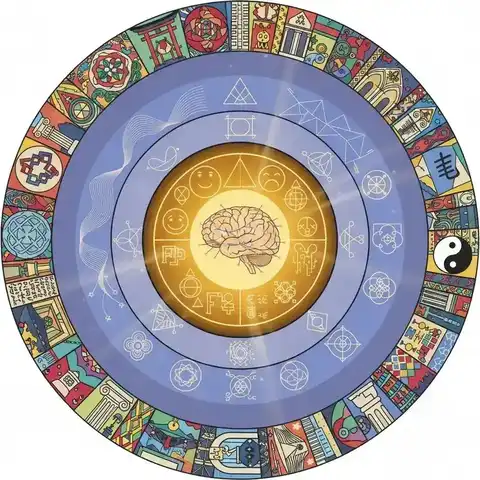
Figure 1. Conceptual illustration of convergence: from cultural representations in the outer ring, through abstract structures in the middle ring, to universal cognitive cores at the center. AI-generated illustration.
Abstract
I argue that the convergence between artificial and human representations reflects objective structures in reality, an aesthetic realism grounded in empirical findings. Starting from the Platonic Representation Hypothesis, I show that human cognition converges at three levels, from evolutionary core structures through abstract concepts to culture-specific representations, and I derive principles for cross-cultural art.
Keywords: platonic representations, neural convergence, neuroaesthetics, fractal aesthetics, embodied simulation, cultural cognition, artificial intelligence
1. Introduction
If different systems, biological and artificial, independently converge on the same representations of reality, this suggests that there are objective structures in the world itself. I argue that such convergence provides grounds for an empirically informed aesthetic realism. The article presents AI convergence, three levels of human convergence, embodied resonance, implications for art, and finally an objection and reply.
2. The Platonic Representation Hypothesis
By platonic representations I mean modality-invariant structures toward which different cognitive systems converge independently of implementation. Huh et al. (2024) show that AI models trained on different data and built with different architectures converge on shared representational structures. Covariance matrices of color in natural images produce representations that align with both human perceptual color space and language-model color concepts. Formally, contrastive learners converge toward a modality-invariant core structure. This is not Plato’s transcendent world of Forms in the strict sense, but something closer to Aristotle: the form is immanent in the data themselves.
3. Level 1: Deep platonic core structures
If AI systems converge on shared representations, the question is whether human cognition exhibits an analogous structure. The first level shows the strongest convergence: evolutionarily shaped structures present from birth.
Spelke’s work on core knowledge suggests that infants universally grasp object permanence and continuity through innate systems. Ekman argued that six basic emotions are universally recognized, a conclusion supported by Izard. Sauter et al. (2010) found that Himba participants recognized emotional vocalizations, though negative emotions generalized more strongly across cultures than positive ones. Humans also share an approximate number sense across widely different populations.
One of the most robust findings in universal visual aesthetics is the preference for fractal dimension D ≈ 1.3-1.5, documented across natural scenes, mathematical fractals, and Pollock paintings. Taylor et al. (2011) found that mid-range fractals produced substantially better stress recovery, and this preference appears already in early childhood. Taylor’s theory of fractal fluency explains the pattern: the visual system evolved to process the fractal statistics of natural environments, and perceptual fluency generates aesthetic pleasure.
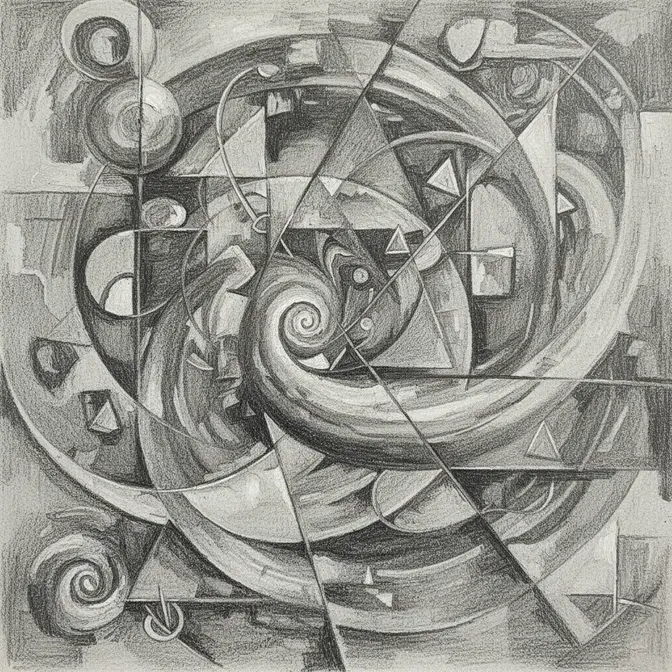
Figure 2. Abstract composition with fractal spirals, geometric forms, and implied motion, structural properties that research suggests appeal across cultures. AI-generated illustration.
4. Level 2: Intermediate abstract concepts
The second level differs from the first in that it concerns abstract concepts acquired through experience but still widely shared across individuals. Wang et al. (2020) showed that abstract concepts have shared neural representations across participants and across English and Mandarin. Botch and Finn (2024) found the complementary pattern: concrete concepts leave individual-specific neural fingerprints, whereas abstract concepts are more universally shared. For art, this implies an important paradox. Realistic painting may activate autobiographical and highly individual memories, whereas abstract art can engage shared representational structures.
Chatterjee and Vartanian (2014) describe three interacting neural systems in aesthetic experience: a sensory-motor system, an emotional-evaluative system, and a meaning-knowledge system. The first two are biologically conserved; the third is culturally saturated. Ishizu and Zeki (2011) found that medial orbitofrontal cortex was active during both musical and visual beauty. Vessel et al. (2012, 2019) showed that the default mode network is engaged by the most moving artworks, and that this response generalizes across visual domains.
5. Level 3: Culture-specific representations
At the third level, cultural variation dominates more clearly, but even here the variation is more limited than one might first expect. Han and Ma’s meta-analysis documents systematic cultural differences in brain activity: East Asian participants show stronger activation in dorsal MPFC, while Western participants show stronger activation in ventral MPFC. Kitayama and Park found that holistic versus analytic cultural styles leave distinct connectome fingerprints. Yet Paige et al. described these cultural differences as relatively subtle: divergence in surface realization rather than in the universal infrastructure itself.
6. Embodied resonance
Freedberg and Gallese argue that the experience of art recruits the mirror neuron system. Umilta et al. (2012) offered direct evidence: suppression of the mu rhythm occurred when participants viewed Fontana’s cuts, but not when they viewed control images. Art that makes action visible invites a form of bodily resonance that may be universal.
7. Implications for the experience of art
The research points toward concrete principles for art with cross-cultural reach. Fractal structure in the range D = 1.3-1.5, together with 1/f² spectral statistics across scales, forms a perceptual core. Motor engagement through visible brushwork and implied movement activates mirror systems, while core-knowledge systems such as object permanence, agency detection, and spatial geometry engage Level 1 structures. Symmetry broken by controlled asymmetry, together with universal emotional channels, can intensify aesthetic response.
Semantic ambiguity is crucial. Highly specific representational content tends to collapse into personal and cultural layers, while abstraction engages the more widely shared structures of Level 2. Formalism was therefore partly right: Bell’s “significant form” points toward universal mechanisms, but aesthetic experience in fact operates across all three levels at once.
8. Objection and reply
If culture changes the brain in fundamental ways, how can one still claim universal convergence? The answer requires distinguishing the levels carefully.
Culture cannot override Level 1 because these structures are evolutionarily encoded from birth, as infant studies suggest. At Level 2, culture modulates representation without eliminating the common core: the neural patterns are statistically shared even if they are not identical. At Level 3, culture dominates more strongly, but Vessel et al. found very low agreement even within a single culture, suggesting that individual variation may exceed cultural variation. The universal aesthetic core therefore does not consist in agreement about what is beautiful, but in a shared neural architecture through which beauty is experienced.
A further epistemic limitation must be acknowledged. Roskies (2008) points out that there remains substantial inferential distance between neuroimaging data and the cognitive conclusions drawn from them. Current methods provide either strong spatial resolution or strong temporal resolution, but never both at once. The patterns discussed here should therefore be understood as statistical regularities rather than a final map of aesthetic experience.
9. Conclusion
These results are compatible with Plato’s intuition that we converge upon ideas that transcend individual experience, but they do not require a separate realm of Forms. The relevant patterns can instead be understood as statistical regularities immanent in reality itself. Redies’ two-channel model captures this neatly: the perceptual channel is universal, while the cognitive channel is culturally variable. Art that maximizes the perceptual channel while remaining semantically open occupies the most promising space for cross-cultural resonance. This convergence does not definitively prove aesthetic realism, but it gives that position serious empirical support.
References
- Huh, M., Cheung, B., Wang, T., and Isola, P. (2024). “The Platonic Representation Hypothesis.” Proceedings of the 41st International Conference on Machine Learning.
- Aristotle. Poetics, chapter 9.
- Spelke, E. S. (1992). “Origins of knowledge.” Psychological Review, 99(4), 605-632.
- Ekman, P. (1994). “Strong evidence for universals in facial expressions.” Psychological Bulletin, 115(2), 268-287.
- Izard, C. E. (1994). “Innate and universal facial expressions.” Psychological Bulletin, 115(2), 288-299.
- Sauter, D. A., Eisner, F., Ekman, P., and Scott, S. K. (2010). “Cross-cultural recognition of basic emotions through nonverbal emotional vocalizations.” PNAS, 107(6), 2408-2412.
- Mortillaro, M., Mehu, M., and Scherer, K. R. (2024). “How emotion is experienced and expressed in multiple cultures.” Frontiers in Psychology, 15, 1350631.
- Halberda, J., and Feigenson, L. (2008). “Developmental change in the acuity of the number sense.” Developmental Psychology, 44(5), 1457-1465.
- Izard, V., Sann, C., Spelke, E. S., and Streri, A. (2011). “Predicting sights from sounds.” Infancy, 16(5), 442-451.
- Redies, C. (2015). “Combining universal beauty and cultural context in a unifying model of visual aesthetic experience.” Frontiers in Human Neuroscience, 9, 218.
- Spehar, B., Clifford, C. W. G., Newell, B. R., and Taylor, R. P. (2003). “Universal aesthetic of fractals.” Computers & Graphics, 27(5), 813-820.
- Taylor, R. P., Spehar, B., Van Donkelaar, P., and Hagerhall, C. M. (2011). “Perceptual and physiological responses to Jackson Pollock’s fractals.” Frontiers in Human Neuroscience, 5, 60.
- Robles, K. E., Liaw, N. A., Taylor, R. P., Baldwin, D. A., and Sereno, M. E. (2020). “A shared fractal aesthetic across development.” Humanities and Social Sciences Communications, 7, 158.
- Koch, M., Denzler, J., and Redies, C. (2010). “1/f² characteristics and isotropy in the Fourier power spectra of visual art.” PLoS ONE, 5(8), e12268.
- Redies, C., and Brachmann, A. (2017). “Statistical image properties in large subsets of traditional art, bad art, and abstract art.” Frontiers in Neuroscience, 11, 593.
- Street, N., Forsythe, A. M., Reilly, R. G., Taylor, R. P., and Helmy, M. S. (2016). “Universal preference vs. individual differences in aesthetic response to fractal patterns.” Frontiers in Human Neuroscience, 10, 213.
- Wang, X., Men, W., Gao, J., Caramazza, A., and Bi, Y. (2020). “Neural representations of abstract concepts.” Cerebral Cortex, 30(4), 2157-2166.
- Vargas, R., and Just, M. A. (2022). “Neural representations of abstract concepts across English and Mandarin.” Human Brain Mapping, 43(15), 4587-4600.
- Botch, T. L., and Finn, E. S. (2024). “Neural representations of concreteness are specific to the individual.” Journal of Neuroscience, 44(45), e0288242024.
- Chatterjee, A., and Vartanian, O. (2014). “Neuroaesthetics.” Trends in Cognitive Sciences, 18(7), 370-375.
- Ishizu, T., and Zeki, S. (2011). “Toward a brain-based theory of beauty.” PLoS ONE, 6(7), e21852.
- Vessel, E. A., Starr, G. G., and Rubin, N. (2012). “The brain on art.” Frontiers in Human Neuroscience, 6, 66.
- Vessel, E. A., Isola, P., Marti, A., Leder, H., and Rubin, N. (2019). “The default-mode network represents aesthetic appeal across visual domains.” PNAS, 116(38), 19155-19164.
- Hasson, U., Nir, Y., Levy, I., Fuhrmann, G., and Malach, R. (2004). “Intersubject synchronization of cortical activity during natural vision.” Science, 303(5664), 1634-1640.
- Sachs, M. E., Kaplan, J., Cades, C., Habibi, A., and Damasio, A. (2024). “Movement synchrony among dance performers predicts brain synchrony among spectators.” Scientific Reports, 14, 22583.
- Han, S., and Ma, Y. (2014). “Cultural differences in human brain activity.” NeuroImage, 99, 293-300.
- Kitayama, S., and Park, J. (2021). “Functional connectome fingerprint of holistic-analytic cultural style.” Social Cognitive and Affective Neuroscience, 16(8), 850-857.
- Levinson, S. C. (2003). Space in Language and Cognition.
- Paige, L. E., Ksander, J. C., Johndro, H. A., and Gutchess, A. H. (2017). “Cross-cultural differences in the neural correlates of recognition.” Cortex, 91, 250-261.
- Broom, T. W., Iyer, S., Courtney, A. L., and Meyer, M. L. (2024). “Loneliness corresponds with neural representations and language use that deviate from shared cultural perceptions.” Communications Psychology, 2, 40.
- Freedberg, D., and Gallese, V. (2007). “Motion, emotion and empathy in esthetic experience.” Trends in Cognitive Sciences, 11(5), 197-203.
- Umilta, M. A., Berchio, C., Sestito, M., Freedberg, D., and Gallese, V. (2012). “Abstract art and cortical motor activation.” Frontiers in Human Neuroscience, 6, 311.
- Sasaki, Y., Vanduffel, W., Knutsen, T., Tyler, C., and Tootell, R. (2005). “Symmetry activates extrastriate visual cortex.” PNAS, 102(8), 3159-3163.
- Rabbas, O., Apelseth, A., Apeland, A. L., and Stigen, A. (eds.) (2023). Det gode, chapter 10.
- Roskies, A. L. (2008). “Neuroimaging and inferential distance.” Neuroethics, 1(1), 19-30.
Gallery